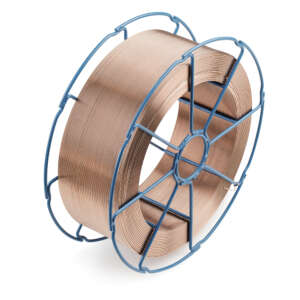
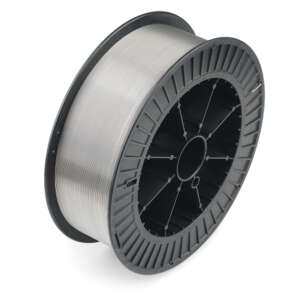
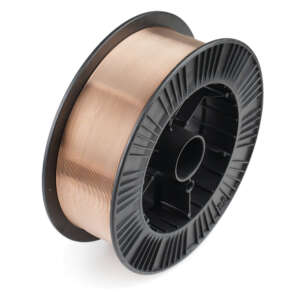
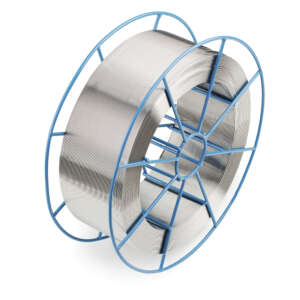
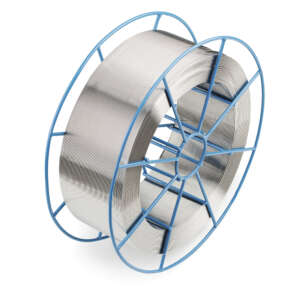
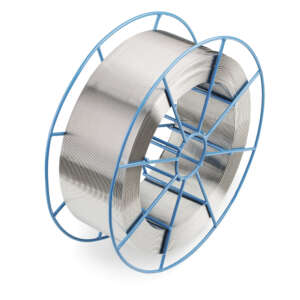
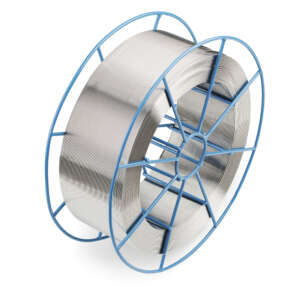
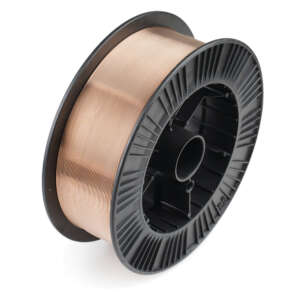
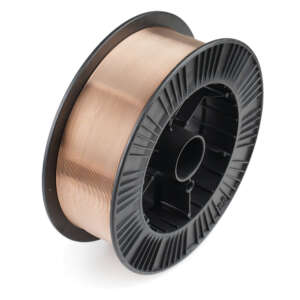
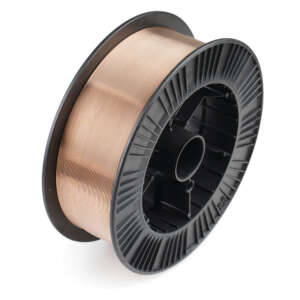
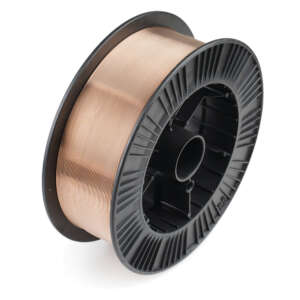
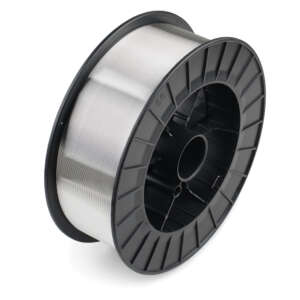
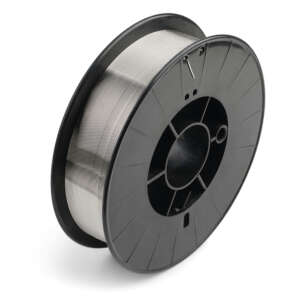
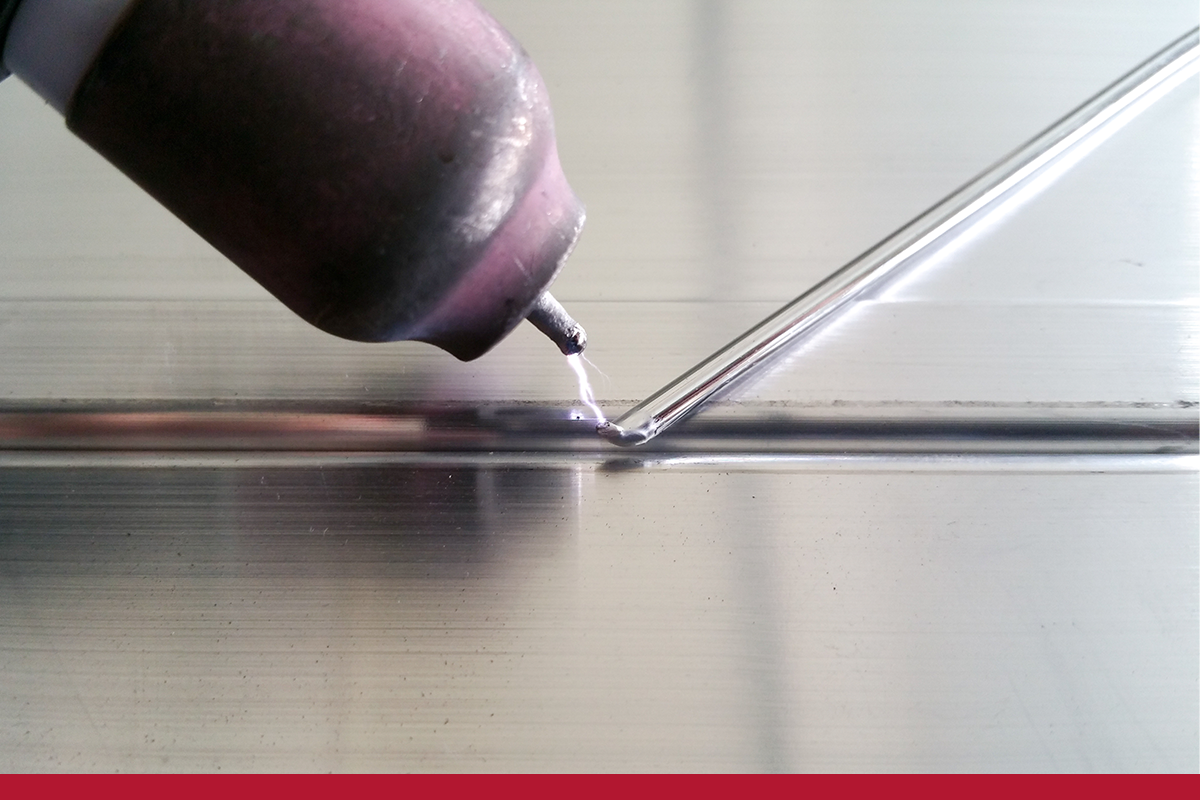
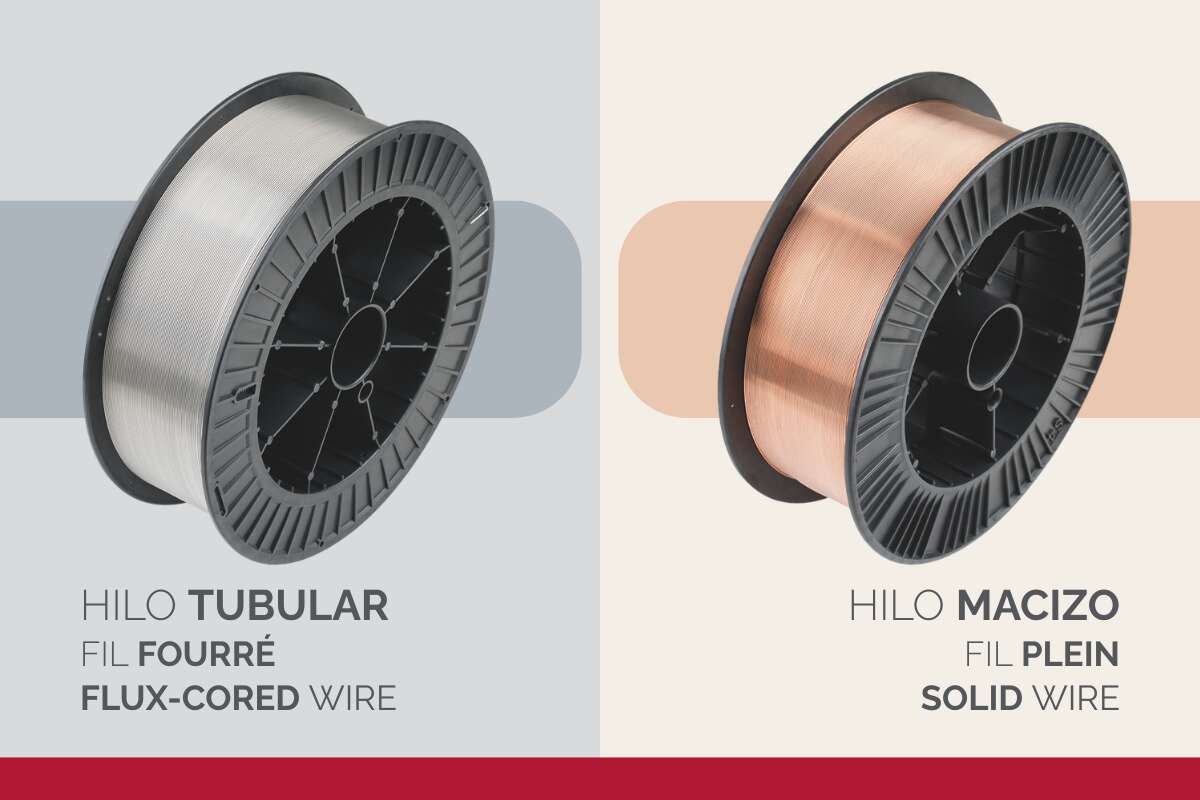
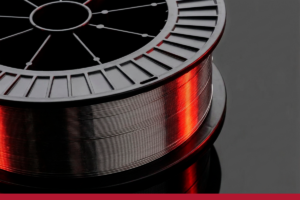
Solid wire is a consumable with a uniform cross-section and no inner core, used primarily in MIG/MAG continuous-feed welding processes. Unlike flux-cored wire, it does not contain flux or metal powder inside, and therefore requires an external shielding gas to form the weld bead. The choice of the appropriate wire depends on the base material to be welded, as each alloy requires a compatible chemical composition to prevent defects such as cracks, porosity or loss of mechanical properties.
Clasificación del hilo macizo según el material base
Solid welding wire is grouped into families according to the base material to be welded: carbon steel, stainless steel, Corten steel, high-yield-strength steel, copper and its alloys, aluminium and its alloys, and hardfacing. Within each family, there is usually a main grade, which is the most commonly used, and variants whose chemical composition is tailored to a specific base steel, working environment or mechanical requirement.
Solid wire for carbon steel
Solid wire for stainless steel
316LSi is suitable for austenitic stainless steels such as AISI 316 and AISI 316L, offering good resistance to intergranular corrosion. The stainless steel wire range also includes 308LSi (recommended for 304-type steels), 309LSi (for dissimilar carbon steel–stainless steel joints), 307Si (for joining dissimilar steels), 310 (resistant to oxidation up to 1100 °C), 312 (high resistance to hot cracking) and the duplex ER2209 (for austenitic-ferritic steels).
Solid wire for Corten steel
The ER80S-G (Corten) is a copper- and nickel-alloyed wire suitable for welding weather-resistant steels; it offers good toughness at low temperatures and is suitable for joints requiring high mechanical strength.
Solid wire for high elastic limit steel
Solid wire for copper and alloys
ERCuSi-A is suitable for brazing copper-silicon and copper base metals, and can also be used for hardfacing on ferritic-pearlitic steels. The range also includes the ERCu (CuSn), for brazing pure or low-alloy copper, and the ERCuAl-A1, an aluminium bronze for brazing copper alloys and hardfacing, offering good resistance to wear and corrosion in seawater.
Solid wire for aluminium and alloys
Solid surfacing wire
The MSG 6-60 is a solid wire for hardfacing parts subject to high levels of abrasion and impact, with a hardness of 600 HV (57–62 HRC), suitable for restoring worn components.
Comparison of solid yarn by base material
Base material | Designation / standard | CHAVESBAO reference | Typical application |
Carbon steel | G3Si1 (UNE-EN ISO 14341-A) | GW ROLLER 2.10 | Construction, metalwork, shipbuilding |
Stainless steel | 316LSi (UNE-EN ISO 14343-A) | GW ROLLER 2.31 | Industry, boiler making, heat exchangers |
Corten steel | ER80S-G (UNE-EN ISO 14341-A) | HILO ER80S-G | Outdoor structures, high mechanical strength |
High elastic limit steel | ER100S-G (UNE-EN ISO 16834-A) | HILO ER100S-G | Offshore, chemical and petrochemical industries |
Copper and alloys | ERCuSi-A (UNE-EN ISO 24373) | HILO ERCuSi-A | Copper parts, hard-faced onto steel |
Aluminium and alloys | ER4043 (UNE-EN ISO 18273-A) | GW ROLLER 2.51 | Lightweight structures, corrosive environments |
Surfacing | MSG 6-60 (hardness 600 HV / 57–62 HRC) | HILO MSG 6-60 | Restoration of parts worn by abrasion or impact |
Available diameters
The available diameter varies depending on the product code. All product codes mentioned in this text, including secondary variants based on material, have been checked individually on their product data sheets:
Material | Reference | Norma | Available diameters (mm) |
|---|---|---|---|
Carbon steel | G3Si1 | UNE-EN ISO 14341-A | 0.6 / 0.8 / 1.0 / 1.2 / 1.6 |
Carbon steel | G4Si1 | UNE-EN ISO 14341-A | 0.8 / 1.0 / 1.2 |
Carbon steel | 316LSi | UNE-EN ISO 14343-A | 0.8 / 1.0 / 1.2 |
Stainless steel | 308LSi | UNE-EN ISO 14343-A | 0.8 / 1.0 / 1.2 |
Stainless steel | 309LSi | UNE-EN ISO 14343-A | 1.0 / 1.2 |
Stainless steel | 307Si | UNE-EN ISO 14343-A | 1.0 / 1.2 |
Stainless steel | 310 | UNE-EN ISO 14343-A | 1.0 / 1.2 |
Stainless steel | 312 | UNE-EN ISO 14343-A | 1.2 |
Stainless steel | ER2209 (dúplex) | UNE-EN ISO 14343-A | 1.2 |
Corten steel | ER80S-G | UNE-EN ISO 14341-A | 1.0 / 1.2 |
High elastic limit steel | ER100S-G | UNE-EN ISO 16834-A | 0.8 / 1.0 / 1.2 |
High elastic limit steel | ER110S-G | UNE-EN ISO 16834-A | 1.0 / 1.2 |
Alloyed copper | ERCuSi-A | UNE-EN ISO 24373 | 0.8 / 1.0 / 1.2 |
Alloyed copper | ERCu (CuSn) | UNE-EN ISO 24373 | 1.0 / 1.2 |
Alloyed copper | ERCuAl-A1 | UNE-EN ISO 24373 | 1.2 |
Aluminium and alloys | ER4043 | UNE-EN ISO 18273-A | 1.0 / 1.2 |
Aluminium and alloys | ER5356 | UNE-EN ISO 18273-A | 0.8 / 1.0 / 1.2 |
Aluminium and alloys | ER5183 | UNE-EN ISO 18273-A | 1.0 / 1.2 |
Surfacing | MSG 6-60 | – | 1.0 / 1.2 |
How to choose the right solid wire
The selection of solid wire must be based on the base material and its composition, followed by the thickness of the workpiece, the welding position and the shielding gas available, as the quality of the weld bead depends directly on this combination. Incorrect metallurgical compatibility between the wire and the base material can lead to cracks, lack of fusion or a loss of properties following the process.
At CHAVESBAO, we work with both types – solid wire and flux-cored wire – for the various MIG/MAG and FCAW welding processes. Browse the categories for solid wire and flux-cored wire and consult our technical team to determine which consumable best suits your process.